What is an Establishment anymore? How could it change and who benefits?
Aside from being one of the longest non-scientific words in the English language antidisestablishmentarianism also refers to an opposition to those who oppose the Establishment.
In 19th century Britain that meant fighting liberal proposals for the disestablishment of the Anglican Church as the state Church of England, Ireland, and Wales.
Today, in America, for example, to oppose those who oppose the Establishment, would put you against a new Administration that wants to roll back established policies.
To make it even more confusing, there’s an Establishment corresponding to every single issue in this country by now, from domestic to international. (In fact, that might be politics!)
Establishment simply means a dominant group, in government, or society.[1]; an elite that holds power and authority.
And let’s be clear: any given Establishment is made up of both parties. It re-morphs when a new party comes to town but both sides are well-represented. Industry, heads of state, foreigners, high net worth individuals, civil society, insiders and outsiders, they’re all in there too.
Ah, so it was the standing Establishment Mr. Trump was specifically referring to, which his campaign consistently linked to, before inserting a swamp metaphor.
Fact is, Mr. Trump is part of the Establishment already, and will only increase its size and composition. Which explains all the scurrying officials in Washington these past few weeks – designing a new one.
…It’s tricky. It’s not some ship you board and just steer into anti-establishment waters.
However you slice it, Establishments have had a good run:
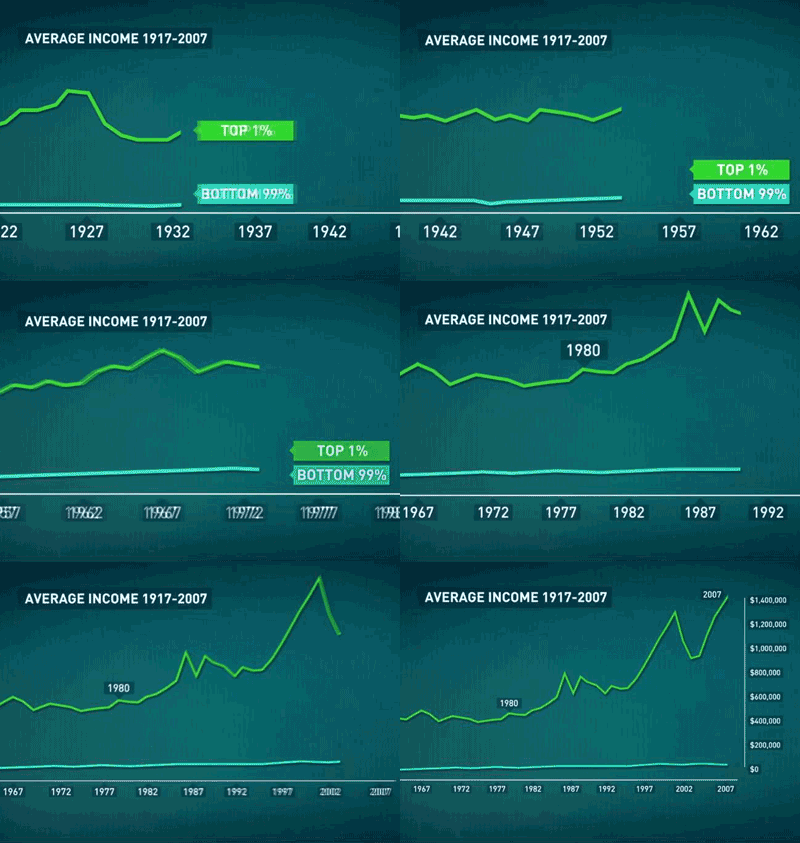
I mean, jeez: the 85 richest people on the planet hold the same wealth as the poorest 3.5 billion people in the world.
Of all income generated by global GDP growth between 1999 and 2008, the poorest 60% of humanity received only 5%.
And now, with the unfathomable wealth being generated by innovation and free trade, inequality is increasing exponentially. Technology (machines) going so far as to eliminate livelihoods, jobs, the future prospects of real people everywhere.
Yet at the same time (over the last 15 years especially), led by the Establishment incidentally, the world has mobilized in historic ways to lift the poor and raise the quality of life for all mankind.
And it’s working.
Much of it due to US leadership and taxpayer money, the world’s population living below the extreme poverty line fell by more than half between 2002-12.
I’m all for breaking down establishments where they don’t work. Dis-establishing under ‘normal’ circumstances – controlled, rational, for an agreed-to stated purpose that benefits us all, not just the elite. Where they do work though, I’d rather grow, gain strength, than go back, be in stasis, or lose equity.
To simply hand things over to new groups of self-interested, ineffectual leaders is a political act that only weakens us. Results – not a rearrangement of the elite – is what the people want.
An optimist, I’m hoping the point Mr. Trump was trying to make is that we’re all part of the establishment. In which case, there wouldn’t be one. Which would be true disestablishment. And, come to think of it, what’s called social justice.

/ / Jan. 5 ’17; KJS
 whatever because