
The Obsolescence Generation: How AI Is Stealing the Future From Our Young
Leading biologists met at the Vatican back in April to brainstorm how to prevent extinction. ‘The living fabric of the world is slipping through our fingers without our showing much sign of caring,’ the report noted.
How to prevent extinction! Kind of big news. Oh, you didn’t read about it?
Maybe because life moves so fast—days as dense as decades—or because tomorrow seems so automated. But what I’m wondering is: why don’t humans pay attention to the future as much as we invest in it?
The Zeitgeist of Human Obsolescence
Zeitgeist is such a cool word. It means the prevailing spirit of the age. Today’s zeitgeist? Making humans unnecessary.
In business, the drive to eliminate fixed costs has existed as long as capitalism itself. The production wave to Asia in the 1980s lowered costs considerably. Every tech business plan for the last decade has been an all-out effort to neutralize labor expenses.
But what’s new and dangerous about this zeitgeist now is how it’s not just reducing human workers—it’s planning to eliminate human necessity entirely.
This is no longer about how cheaply you can run your business to maximize profit. It’s about how you can run it without human workers at all.
The Numbers Are Brutal
The data should terrify every parent saving for college:
AI could wipe out half of all entry-level white-collar jobs and spike unemployment to 10-20% in the next one to five years, warns Anthropic CEO Dario Amodei. He calls it a potential “white-collar bloodbath.”
40% of employers worldwide expect to reduce their workforce where AI can automate tasks, according to the World Economic Forum’s 2025 Future of Jobs Report.
Recent graduates account for just 7% of hires across the fifteen biggest technology companies, with new recruits down 25% compared to 2023.
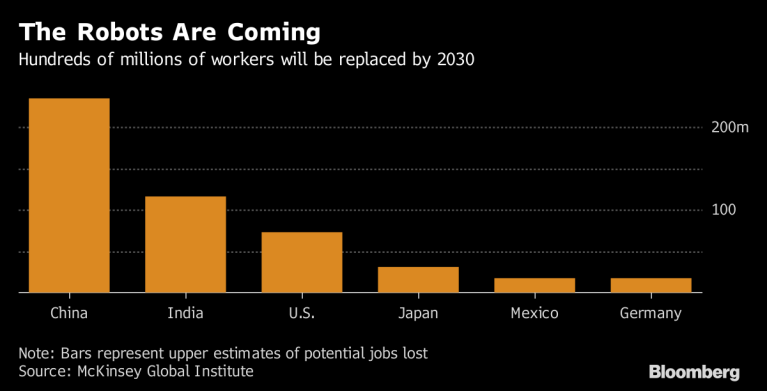
Goldman Sachs reports AI could replace the equivalent of 300 million full-time jobs. That’s not a distant threat—MIT research shows AI will replace 2 million manufacturing workers by 2025. This year.
If you have young kids and are saving for college, you might want to rethink that strategy.
The Youth Sacrifice
While global youth unemployment officially stands at 13%—equivalent to 65 million young people—that number obscures a deeper catastrophe. **52% of individuals aged 18 to 24 express worries about AI’s impact on their future careers.** They should be worried.
*49% of US Gen Z job hunters believe AI has already reduced the value of their college education in the job market. They’re not wrong. Two-thirds of young people globally experience anxiety about their job prospects, and they’re watching their entry points into the economy vanish in real time.
*Youth unemployment now hits 16% in upper-middle-income countries. In regions where young people were already struggling—Arab States, North Africa—youth unemployment rates remain “critically high.” Nearly three-quarters of young adults in sub-Saharan Africa are stuck in insecure employment.
The message is clear: We’re creating the most educated generation in history for jobs that won’t exist.
The Cult of Singularity
This technological pursuit has grown into its own religion. It’s well documented—the cultural and operating model of Silicon Valley’s tech community. They even have universities devoted to accelerating what they call “Singularity” (capitalized like God). Their big bang: the threshold when machines replace human competency.
Singularity has become a fanatical elitist cult with no regard for what comes next. Just a God complex that’s staggering. Like Kool-Aid, tech stocks keep flowing while we forget about a worker-less future. This is one chapter in their gospel—a multi-sectoral vision to replace the human species.
Is this really the height of human ingenuity—racing to replace ourselves?
This isn’t doomsday prophecy or Luddite nostalgia. It’s a simple question no one is asking: BTW Are biotech, AI, and robotics inherently elitist creations? Will only those who can afford them gain from their exponential power, driving the rest of us to relearn survival without such advantages?
The Science Fiction Plot We’re Living
We’re watching the plot structure of every decent science fiction story: the emergence of two extreme classes struggling for resources. In their space pods floating away are the relatively few high-net-worth individuals who gained power by disrupting human livelihoods—perhaps driving homo sapiens to extinction.
The uber-wealthy are literally building secret bunkers for when the masses come for them. This isn’t conspiracy theory—it’s documented business strategy.
Worker-less future. Bunkers. Space travel as exit strategy—hello!…
The Speed of Catastrophe
Technology has been disrupting job markets since there were markets. But there’s a fundamental difference between innovations like fire, the wheel, the printing press, and the scale and speed of AI automation.
This change is happening ten times faster and at 300 times the scale of the Industrial Revolution—roughly 3,000 times the impact. Before “extinctive technologies,” innovations happened over longer periods, affecting fewer sectors simultaneously.
The sheer scale and speed make this mass displacement unparalleled in history.
First it was factories in the 1980s, then EZ Pass, soon cars driving themselves. The next massive wave: retail, then white-collar jobs—financial planners, lawyers, accountants. How long before we have RoboCops and RoboSoldiers?
The Education Trap
If no one can plan a livelihood, what is the value of education?
Do you teach your kids to compete against software, become its creator, or befriend it? Do you find a trade that isn’t being automated—like hair styling? Do something only humans can do—like art? Master a uniquely human service—like masonry?
77% of AI-related jobs require master’s degrees, and 18% require doctoral degrees. We’re creating an economy where only the highest-educated can work alongside their digital replacements, while everyone else becomes obsolete.
No Questions Asked
This is all happening now. But because it’s happening in an “open society” atop “free markets,” the question isn’t whether it’s right—just what comes next.
Companies and entrepreneurs aren’t held accountable; they’re lionized. Stephen Hawking, Bill Gates, and Elon Musk warned us publicly, but no philosopher is holding court. No regulatory body exists to vet AI development.
We’re more prepared to defend against terrorism than to create jobs for displaced demographics.
With unprecedented distrust between government and industry, between old and new economies, there are no guardrails in the race toward species-altering technology.
Sorry, kids.
The Pascal Problem
Blaise Pascal said: “All of humanity’s problems stem from man’s inability to sit quietly in a room alone.” We fear the silence of existence, dread boredom, choose aimless distraction, and run from emotional problems into false mental comforts.
But here’s the twist: What happens when massive numbers of people—especially young men—have nothing to do because their jobs have been automated away?
Massive job displacement for drivers, factory workers, military, and police equals millions of people with nothing to do. When people don’t have livelihoods, they will stop at nothing.
Technology promised to enhance life, not escape it. Instead, it’s become our new religion.
The Refusal
I have a problem with anyone else planning my obsolescence. I refuse to deploy in this unannounced war against homo sapiens.
I don’t need AI writing my emails, planning my schedule, or thinking my thoughts. I’m not against technology—I’m against everything becoming technology. I’m against it being the constant hero while hatching exit strategies without our consent.
If business and technology invested in social outcomes as they do in financial ones, maybe we wouldn’t need to fight our way onto the last spaceship leaving Earth.
The Generation We’re Abandoning
Today’s young people are inheriting an economic system designed to eliminate their usefulness. They’re getting college degrees for jobs that will be automated before they graduate. They’re accumulating debt for skills that software will perform better and cheaper.
We’re creating the first generation in human history whose very existence is treated as inefficient.
The question isn’t whether this technological revolution will happen—it’s already happening. The question is whether we’ll choose to include human flourishing in the design, or whether we’ll just optimize humans out of existence.
Our young people deserve better than becoming the obsolescence generation.
They deserve a future where technology serves humanity, not the other way around. Where innovation creates opportunity, not eliminates it. Where being human is still an advantage, not a liability.
But that future requires us to ask the hard questions now, before the choice gets made for us.
Before we automate away not just jobs, but the very idea that human life has value beyond its productivity metrics.
// 8/2025 updated 05/17/17 KJS
 whatever because