Update, orig. 6/30/07 KJS
Roosevelt was No Island: Conservative Manifesto for a Dying Planet
There is an island off the coast of Washington D.C., squeezed between Virginia and the District. Away from the crowds, a tiny sanctuary looks like it floated upriver from the past—trickling pools, unpaved trails, towering trees lapping the shores of the nation’s capital.
Theodore Roosevelt got his own island. A reserve fitting the ultimate outdoorsman, one of America’s first true environmentalists.
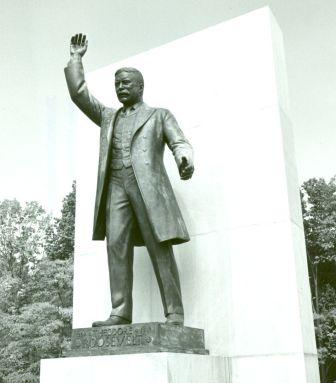
Stand on Roosevelt Island today and you’ll feel him breathing down your neck. Look back through the trees—there’s his massive statue, thick eyebrow arched, strong neck bulging, meaty forearm raised like a hammer ready to strike.
It’s almost nerve-racking how clear and honest they were back then.
The Reckoning
Today we drown in indecision as rain forests vanish, reefs bleach, and deserts swallow cities. In 2024 alone, we lost 16 million acres of forest—an area bigger than West Virginia. Half of all tropical forests have disappeared. Wildfire became the largest driver of tropical forest loss for the first time, responsible for almost half the destruction.
We’ve modified 75% of all ice-free land. We control 75% of Earth’s freshwater. We’ve lost 85% of wetlands. One million species face extinction—many within decades.
What Roosevelt Knew
This is the choice: money for companies now versus clean air, oceans, and a livable planet forever.
Roosevelt had no patience for line-straddlers, corporate sellouts, or shortsightedness. He refused procrastination as mere indecision. To him, nature was a right—part of what we are, an undeniable need.
“Defenders of the short-sighted men who in their greed and selfishness will, if permitted, rob our country of half its charm… The ‘greatest good for the greatest number’ applies to the number within the womb of time, compared to which those now alive form but an insignificant fraction.”
During his presidency, Roosevelt set aside 240 million acres as national parks, forests, monuments, and wildlife refuges. He created the U.S. Forest Service, established 150 national forests, 51 federal bird reserves, 4 national game preserves, 5 national parks, and 18 national monuments. He protected public land when the pressure to exploit was overwhelming.
The Roosevelt Test
How would Roosevelt handle Congress today, knowing that existing policies have fallen so catastrophically short? How fired up would he be, seeing the almighty dollar gutting our earthscape?
A hundred years later, you still wonder how universal ideals got so lost:
– That preservation of homeland doesn’t include treasuring nature
– That we don’t hold business accountable for destruction
– That we rely on extractive habits while appearing too lazy to change
– That leadership across all sectors lacks the ability to protect the future
How did conservation become a “leftist” idea?
Money. Business. Enterprise. Growth. Greed. Selfishness. Inequity. Unnatural incentives. Lack of oversight. All the obvious reasons Roosevelt warned us about.
The Human Cost
Science proves contact with nature benefits human health. We’re hard-wired with a biological preference for natural settings. Patients with views of trees have shorter hospital stays and need less pain medication than those staring at brick walls.
But we’re cutting ourselves off from what keeps us sane. Is the shrinking wilderness actually making us sick? Recent studies on anxiety, allergies, ADD, and depression point to humans struggling with modern life severed from natural patterns.
We can’t adjust to “days as dense as decades” without nature’s rhythm. Our antibodies and neurological responses can’t handle constant over-stimulation.
The Real Numbers
Agriculture drives 80% of global deforestation. The world’s forests have decreased by 31% since agriculture began. Biodiversity is declining faster than at any time in human history—native species abundance has fallen at least 20% since 1900.
Up to one million species are threatened with extinction, many within decades. Parts of the Amazon rainforest are turning from carbon sinks into carbon sources.
Between 2015 and 2019, at least 100 million hectares of productive land were degraded annually.
This isn’t about polar bears and tree-huggers. This is about our survival next.
The Efficiency Argument
How much will it cost to replace essential resources—if that’s even possible? Moving to a new planet in 50 years? Giving up on this one?
Over half of global GDP depends on nature. More than 1 billion people rely on forests for their livelihoods. Land and ocean absorb more than half of all carbon emissions.
Spending money later will be infinitely more expensive than saving what we have now.
Roosevelt understood: nature’s abundance will always repay us, no matter what conservation costs.
The Current Betrayal
In 2024, Utah petitioned the Supreme Court to transfer 18.5 million acres of federal lands to state ownership—making all 640 million acres of public lands vulnerable to sale. Mandated public land sales were proposed in Congress.
We’re witnessing the systematic dismantling of America’s conservation legacy.
The Roosevelt Response
He’d be building the greatest conservation movement in American history. He’d be using the bully pulpit to shame every politician, CEO, and citizen participating in this destruction.
He’d be shouting from every platform: “This land belongs to the unborn generations!”
The Call
Conservation isn’t a luxury—it’s survival.
Nature isn’t scenery—it’s life support.
Public lands aren’t real estate—they’re sacred trust.
We need leaders with backbone to say: “No more. Not one more acre. Not one more species. Not one more degree of warming.”
We need a conservation movement as fierce as the forces destroying our planet.
We need moral clarity: that leaving a habitable world for our children isn’t negotiable.
The Challenge
Roosevelt believed wild places should be accessible to all Americans, not just the wealthy. His vision stood against European models where nature belonged to the crown.
Today’s challenge: advance Roosevelt’s conservation vision against unprecedented threats—development, climate change, corporate capture—while ensuring all Americans have access to the outdoors.
Roosevelt’s statue stands on that island, arm raised like a hammer, because he knew conservation requires force. Not violence—moral force. Political force. The force of absolute conviction that nature’s destruction ends here.
 whatever because