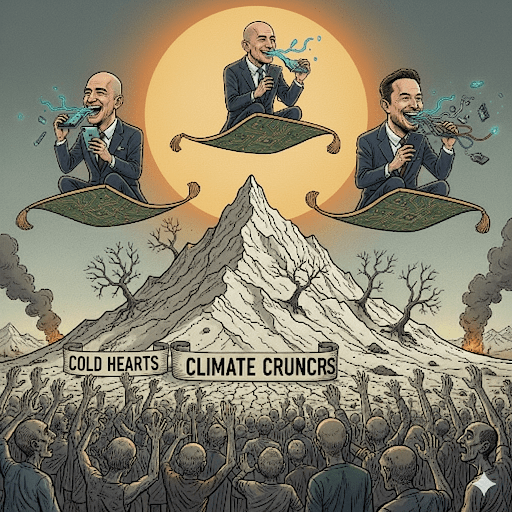
A Deep Dive into the Shamefully Low Philanthropic Output of Larry Ellison, Elon Musk, and Jeff Bezos.
Uncomfortable Truth: Three men control over $1 trillion in wealth yet give away less than 2% of their fortunes while billions suffer. Larry Ellison ($393 billion), Elon Musk ($385 billion), and Jeff Bezos ($241 billion) represent the most striking example of wealth hoarding in human history. Their combined resources could solve multiple global crises, yet they choose self-serving “philanthropy” that primarily benefits their own interests.
Larry Ellison: World’s Richest Miser
Despite signing the Giving Pledge in 2010 and promising to give away at least 95% of his wealth, Ellison’s actual giving remains microscopic relative to his fortune. Recent analysis reveals a pattern of broken promises and redirected commitments.
The Broken Harvard Promise: In 2006, Ellison reneged on his $115 million pledge to Harvard University when former president Lawrence Summers departed, demonstrating how his “philanthropy” depends on personal relationships rather than genuine commitment to causes.
Giving Pledge Revision: In July 2025, Ellison announced he was “amending” his Giving Pledge commitment, shifting focus away from traditional nonprofits toward his own Ellison Institute of Technology at Oxford—a move that essentially allows him to fund his own interests while claiming charitable intent.
The Numbers: With a net worth exceeding $393 billion, even a conservative 5% annual giving rate would mean $19.65 billion per year. There’s no evidence Ellison approaches even 1% of this target.
Key philanthropic focus: His giving has focused on medical research, particularly through the Lawrence J. Ellison Musculo-Skeletal Research Center, and conservation efforts on the Hawaiian island of Lānaʻi — which he owns.
Elon Musk: Self-Serving “Charity”
Musk’s philanthropic record is perhaps the most egregious example of using charity structures for personal benefit.
The Foundation Scandal: In 2021 and 2022, the Musk Foundation awarded less than 5% of its assets in donations, falling short of the legal minimum required to maintain tax-exempt status. Meanwhile, most of the foundation’s $237 million in 2022 gifts went to entities controlled by Musk himself.
Tax Avoidance Through “Giving”: Musk’s donation of $5.7 billion in Tesla shares to his foundation in 2021 allowed him to avoid up to $2 billion in taxes—money that should have gone to public services.
The School Scam: A major recipient of Musk Foundation grants has been Ad Astra, a school founded by Musk where his own children attend alongside children of his executives. This isn’t philanthropy; it’s subsidizing private education for the wealthy.
Biographer’s Assessment: According to Walter Isaacson, Musk has little interest in traditional philanthropy, believing he can do more for humanity by keeping money in his companies—a convenient rationalization for hoarding.
Jeff Bezos: The Reluctant Giver
Bezos stands out as the only one of the three who hasn’t signed the Giving Pledge, and his giving record reflects this reluctance.
Giving Percentage: Forbes ranks Bezos at No. 9 on its 2025 list of America’s Most Generous Philanthropists, with lifetime giving of $4.1 billion—just 1.6% of his net worth.
Earth Fund Delays: While Bezos announced a $10 billion climate commitment in 2020, as of 2025, he has distributed only $2 billion of that pledge—20% in five years, suggesting the full amount won’t be distributed until 2045 at this pace.
Strategic vs. Urgent: Critics note that Bezos hasn’t signed the Giving Pledge and his approach is described as “more measured and strategic”—code for slow and insufficient given the scale of global crises.
Devastating Comparison: How Real Philanthropists Give
The contrast with genuine philanthropic leaders is stark:
Warren Buffett: The Gold Standard
– Lifetime giving: $62 billion (30% of net worth)
– Has given away so much that it dropped him from 8th to 10th richest person globally
– Co-founded the Giving Pledge and has actually followed through
MacKenzie Scott: Speed and Scale
– Has given away $19.25 billion (36% of her net worth)
– Committed to “keep at it until the safe is empty”
– Practices “stealth giving”—trusting recipients without bureaucratic oversight
Bill Gates: Systematic Impact
– Lifetime giving: $47.7 billion (26% of combined net worth with Melinda French Gates)
– Recently announced he’s donating 99% of his Microsoft stock and shuttering his foundation within 20 years
Fun Side Exercise
The $108 Billion Question: What Their Combined 10% Could Solve
Taking just 10% of Ellison, Musk, and Bezos’s combined $1.08 trillion wealth ($108 billion) would create unprecedented opportunities for global transformation:
End World Hunger: $40 Billion Annually
The UN World Food Programme estimates it would take $40 billion per year to end world hunger by 2030. With $108 billion, these three could fund nearly three years of global hunger elimination—or create an endowment generating $3-4 billion annually in perpetuity.
The Scope: This would feed 828 million hungry people globally, including 50 million on the brink of famine.
Solve the Global Water Crisis: $35 Billion One-Time
World Resources Institute research shows securing water for global society by 2030 would cost just over 1% of global GDP—approximately $35 billion annually from 2015-2030. A $108 billion investment could provide clean water access for decades.
The Impact: This would serve 2.2 billion people lacking safe water access and 3.5 billion lacking safe sanitation. The economic returns are massive: every $1 invested yields $5.50 in economic returns.
Transform Global Healthcare: $30 Billion Annually
With the remaining $38 billion after addressing hunger and water, these men could:
– Build healthcare infrastructure in developing nations
– Fund vaccine research and distribution globally
– Establish medical research centers focused on diseases affecting the global poor
– Provide clean water access to 3,000 healthcare facilities, serving 2.7 million people, as World Vision aims to do with far smaller resources
Climate Change Acceleration: $108 Billion for Renewable Transition
Alternatively, the full amount could fund:
– Massive solar and wind farm installations across developing nations
– Carbon capture technology development and deployment
– Green infrastructure projects in the world’s most vulnerable regions
– Research into breakthrough climate technologies
The Opportunity Cost: What We’re Missing
Daily Waste
While these three men see their wealth grow by billions monthly, more than 1,000 children under 5 die every day from diseases related to lack of clean water, sanitation, and hygiene. Every 2 minutes, a child dies from a water or sanitation-related disease.
Economic Multiplier
Research shows that eliminating global hunger would boost global GDP by $276 billion in 2030. For severely affected countries like Ethiopia and Zambia, gains would range 4-6% of national GDP. These men are literally holding back global economic growth.
The Time Factor
Women and girls spend 200 million hours every day collecting water. Universal access to basic water and sanitation would result in $18.5 billion in economic benefits annually from avoided deaths alone.
Try not to Judge
The final words on these game-changers could very well be about what they didn’t do with their luck and privilege. Are these the smallest heart-ed privileged people who ever roamed the face of the earth?
To live with such a small heart seems painful. Sure, we can assume narcissistic ingrate, but to have deep pockets with short arms – especially with the state of the world the way it is – has to more complicated that that.
The Psychology of Hoarding: Narcissistic Rationalization
Each has developed elaborate justifications for their hoarding:
Musk’s Company-as-Charity Delusion: Musk has declared his for-profit ventures (Tesla, SpaceX, Neuralink) are “all philanthropy,” claiming they have higher social purpose. This convenient fiction allows him to avoid actual charitable obligations while maintaining a savior complex.
Ellison’s Institute Pivot: By creating his own “institute,” Ellison can claim charitable work while funding his personal interests in technology and longevity research.
Bezos’s Strategic Stalling: Bezos frames his slow giving as “strategic,” but strategy that takes decades while people die is indistinguishable from apathy.
Hearts and Ego’s
These are very visionary people. You mean to tell me they haven’t thought about this, nor has any one around them reminded them of the scaled change they could create. Do they not know what they can achieve; or do they know, and chose not to achieve it?
Systemic Failure
Tax Avoidance Through Foundations: Since 2020, Musk has donated around $7 billion of stock to his foundation, saving himself approximately $2 billion in tax payments. This isn’t philanthropy—it’s tax avoidance subsidized by taxpayers.
The 5% Minimum Scandal: Current law requires foundations to distribute only 5% annually, and critics argue this should be raised to 10%. Even this minimal requirement is routinely ignored, as Musk’s foundation demonstrates.
Democratic Accountability: The concentration of philanthropic power in private foundations undermines democratic accountability. These men get to decide which global problems deserve attention while avoiding public oversight of their choices.
A Path Forward: What Must Change
Policy Reforms Needed
1. Increase Foundation Payout Requirements: Raise the minimum from 5% to 10% annually
Clawback Provisions: If foundations fail to meet distribution requirements, charitable deductions should be reversed
– Transparency Requirements: All foundation grants must be publicly disclosed in real-time
– Billionaire Wealth Tax: Progressive taxation that prevents excessive accumulation
Cultural Shift Required
The era of billionaire vanity philanthropy must end. Women philanthropists like MacKenzie Scott are already modeling a different approach with “stealth giving” that trusts recipients rather than imposing bureaucratic oversight.
Moral Reckoning
In an age of unprecedented inequality and global crisis, the hoarding behavior of Ellison, Musk, and Bezos represents moral failure on a historic scale. They possess the resources to eliminate humanity’s most pressing problems yet choose personal aggrandizement over global good.
While 77% of America’s billionaires have given away less than 5% of their wealth, and 41% have contributed less than 1%, these three stand out for their particularly egregious records.
Their legacy will ultimately be defined not by the rockets they built or the databases they created, but by the suffering they chose to perpetuate through inaction. With $1.08 trillion in combined wealth, they could be remembered as the generation that ended extreme poverty, solved the water crisis, and accelerated climate solutions.
Instead, they’re choosing to be remembered as the richest misers in human history—men who had everything and gave nothing when the world needed them most.
The choice remains theirs. It’s not our money. The clock is ticking. Everyone’s clock.
But maybe they are islands.
—–
*Sources: All claims are backed by recent financial filings, Forbes analysis, Bloomberg Billionaire Index, academic research, and investigative reporting from 2022-2025.*
 whatever because