I was worth millions on paper during the dotcom bubble. I watched companies make decisions based on fantasy valuations. I saw how circular financing schemes created market signals that had nothing to do with reality. I watched it all collapse and cut portfolios in half.
What’s happening with AI data centers right now follows the exact same pattern. Except this time, when the bubble bursts, it won’t just destroy stock portfolios. It will leave behind poisoned communities and environmental debt that lasts generations.
Circular Financing Is Back
Nvidia announced it will invest $100 billion in OpenAI so OpenAI can buy Nvidia systems. OpenAI partners with SoftBank to fund Oracle data centers that will buy more Nvidia chips.
This is AOL Time Warner all over again—companies flooding customers with cash so customers can spend that cash back on their services. It’s financial engineering designed to inflate revenue figures and stock prices.
In the dotcom era, when the music stopped, we got worthless websites and empty office buildings. This time, we’re getting data centers that consume as much electricity as cities, built in places that can’t support them, with environmental permits that don’t exist.
Memphis: The Canary in the Coal Mine
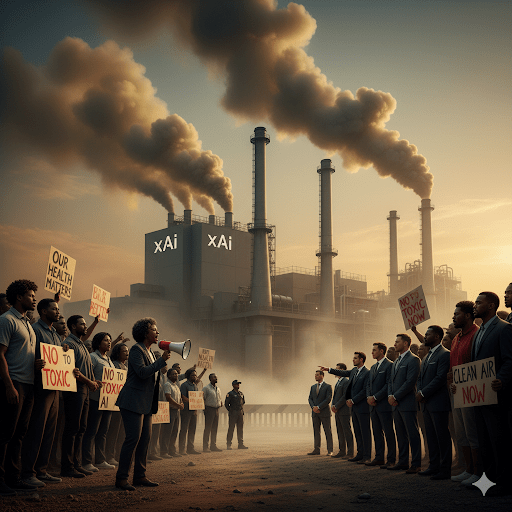
In Memphis, xAI (Musk Corp) and others are building data centers that require so much power they’re running unpermitted natural gas turbines. The air quality violations are immediate and measurable. The community didn’t consent to becoming a sacrifice zone for AI training.
*The company’s “Colossus” supercomputer data center project in South Memphis has drawn significant controversy:
– Unregulated Emissions Concerns: xAI has been accused by environmental groups and community advocates, including the Southern Environmental Law Center (SELC) and the NAACP, of operating dozens of methane gas turbines at the site without the required air pollution permits. These turbines are estimated to generate significant amounts of smog-forming nitrogen oxides (NOx) and other pollutants, raising serious health concerns in the surrounding, predominantly Black, community.
-Lack of Community Input/Transparency: The project’s development has been criticized for being handled in secret, with local utility officials reportedly signing NDAs and the process lacking transparency and input from the directly affected communities.
This isn’t an isolated incident. It’s the business model.
When you’re spending $500 billion on data centers and the clock is ticking on investor expectations, you can’t wait for environmental reviews or community input. You can’t spend two years getting proper permits when the bubble might burst in eighteen months.
So you build where regulations are weak and communities can’t fight back.
Use What We Already Have
America has thousands of brownfield sites—former industrial areas with existing electrical infrastructure, transportation access, and zoning that supports heavy industrial use. Many are specifically designed for high-power operations.
But brownfields don’t generate the same investor excitement as “greenfield development.” They don’t let you claim you’re “transforming communities” or “bringing high-tech jobs to rural America.”
More importantly, brownfields have established regulatory frameworks. You can’t skip environmental reviews. You can’t ignore air quality standards. You can’t pretend your data center is a light industrial facility when it consumes more power than a steel mill.
Bubble logic doesn’t work on brownfields. Reality works on brownfields.
The Real Cost
Each major data center requires 50-100 megawatts of continuous power. That’s enough electricity for 50,000 homes. Running 24/7/365.
The companies building these facilities are using natural gas turbines because the electrical grid can’t support the demand. They’re not just consuming massive amounts of energy—they’re creating new pollution sources in communities that never agreed to host them.
When Memphis scales to hundreds of cities—when every region has multiple data centers running unpermitted gas turbines—the air quality impact will be measurable from space.
And for what? So AI can generate more convincing fake essays and synthetic images?
2027 Scenario
Picture this: It’s 2027. The AI bubble has burst. ChatGPT usage has plateaued. The productivity gains everyone promised never materialized. Investment has dried up.
But the data centers are still there. Still consuming massive amounts of electricity. Still running gas turbines. Still polluting communities.
Except now there’s no revenue to support the operations. No investment to fund the cleanup. No market incentive to maintain environmental controls.
You’ve got hundreds of Memphis-style operations scattered across the country, each one a stranded asset with ongoing environmental liabilities. Each one a permanent burden on the communities that didn’t want them in the first place.
The Bubble Pattern
During the dotcom bubble, I watched companies make decisions that only made sense if the stock market kept going up forever. When the market crashed, those decisions looked insane in hindsight.
AI companies are making the same mistake. They’re building infrastructure based on best-case assumptions about continued investment, continued hype, and continued tolerance for environmental damage.
But bubbles always burst. When this one does, the environmental debt will outlast the financial losses by decades.
Rational Infrastructure
If AI companies were serious about sustainable operations, they would:
Build on brownfields with existing electrical infrastructure and environmental oversight.
Locate data centers near renewable energy sources that can actually support the power requirements.
Obtain proper environmental permits before breaking ground, not after residents start getting sick.
Design facilities that can be efficiently repurposed when the AI boom ends.
Work with communities instead of bypassing them through regulatory capture and jurisdictional shopping.
None of this is happening because it doesn’t serve the speculative interests driving current investment.
Memphis Test
Every new data center proposal should pass the Memphis test: Would you want this facility in your neighborhood? With these environmental impacts? Built under these regulatory shortcuts?
If the answer is no, then companies shouldn’t be building them in other people’s neighborhoods either.
But that’s exactly what’s happening. AI companies are using their financial leverage to impose environmental costs on communities that lack the political power to resist.
The Real Innovation
The real innovation in AI isn’t the technology—it’s the financial engineering that allows companies to externalize environmental costs while capturing speculative gains.
This isn’t new. It’s the same pattern that gave us the housing bubble, the dotcom bubble, and every other speculative mania that prioritized financial returns over real-world consequences.
The difference is that this bubble is being built with actual physical infrastructure that will outlast the financial collapse.
Communities & Environment Chose
We’re at a decision point. We can continue allowing speculative investment to drive infrastructure decisions that will have permanent environmental consequences.
Or we can demand that AI development follow the same environmental and community standards as every other industrial activity.
KJS 9.25
 whatever because