* Fiction
KJS 10.25 DC USA 💰
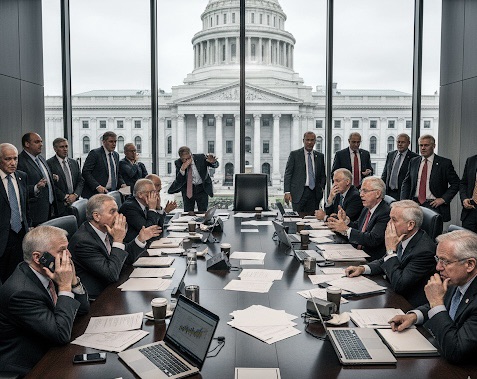
CONFIDENTIAL MINUTES
Emergency Board of Directors Meeting
United States of America, Inc.
PRESENT: Independent Directors, Audit Committee Chair, Compensation Committee, General Counsel
ABSENT: CEO (refused to attend), CFO (position eliminated), Multiple department heads (fired without replacement plans)
CHAIR: Let’s start. We have a crisis that needs immediate action. The company has been shut down for three weeks. No approved budget. No plan for managing money. And the CEO is moving funds around without permission.
AUDIT COMMITTEE CHAIR: I need to say this clearly: our financial controls have completely broken down. The CEO took $6.5 billion from research and development accounts to cover payroll—without asking the board, without filing the required paperwork, and without telling the people who oversee those programs. Senator Murray, who chairs the subcommittee that approves spending, said publicly she doesn’t know what legal authority was used. Senator Murkowski is worried the money came from programs Congress already approved for other purposes. Nobody knows which projects got defunded to pay for this.
DIRECTOR 1: Wait. The CEO is moving billions of dollars between departments without documentation, without approval, and without telling anyone what he’s canceling to cover the bills?
AUDIT COMMITTEE CHAIR: Yes. And it’s part of a pattern. The administration has frozen at least $396 billion in funds the board already approved—money allocated for infrastructure, research, public services, and basic operations. Clean water projects. Roads and bridges. Medical research. All frozen without authorization.
GENERAL COUNSEL: From a legal perspective, we’re in uncharted territory. The CEO claims he has constitutional authority to do something called a “pocket rescission”—essentially the power to veto specific budget items that Congress removed in 1998. The Supreme Court ruled this unconstitutional back in the Nixon administration. We’re operating in direct violation of established law.
DIRECTOR 2: How did we get here? Walk me through the breakdown.
AUDIT COMMITTEE CHAIR: Operations stopped October 1st when the board couldn’t agree on the budget for fiscal year 2025. Normal procedure would be continuing resolutions—keep spending at last year’s levels while we negotiate. Instead, the CEO refused to meet with the minority shareholders, called the shutdown an “opportunity” to kill programs he doesn’t like, and started mass layoffs without board approval.
DIRECTOR 3: Mass layoffs during a funding crisis? That’s not standard procedure.
GENERAL COUNSEL: Correct. The CEO told his team to use the shutdown to make permanent cuts to the workforce. He’s fired 4,200 federal employees in the last week alone. Eliminated entire programs that are required by law—meaning Congress mandated them—with zero staff left to do the work. A CDC researcher said entire divisions with legal obligations have been wiped out with no plan for who takes over their responsibilities.
CHAIR: What about basic operations? Military payroll, for example.
AUDIT COMMITTEE CHAIR: Not sustainable. The CEO announced military personnel would be paid using “all available funds,” but the Pentagon’s R&D budget is finite. This week’s paycheck got covered, but the Speaker—essentially our chief operating officer—said publicly this is a “temporary fix” and service members might miss their October 31st paycheck if we don’t reopen.
DIRECTOR 1: So we’re raiding innovation budgets to cover basic payroll with no long-term plan and no transparency about what’s being cut?
AUDIT COMMITTEE CHAIR: Exactly. And it gets worse. The CEO has been selectively defunding programs based on politics, not operational necessity. He said publicly that “Democrat programs” are being closed permanently while “Republican programs” are safe. He’s frozen $28 billion in infrastructure funding specifically in states with opposition shareholders—California, Illinois, New York.
COMPENSATION COMMITTEE: That’s discriminatory use of company resources based on shareholder political views. That’s a breach of our duty to act in the interest of all shareholders, not just the ones who voted for current management.
DIRECTOR 2: What’s the CEO’s explanation for refusing to negotiate with the board?
GENERAL COUNSEL: He cancelled a scheduled meeting with minority leaders. Won’t participate in budget negotiations. Republican board members are publicly questioning whether he’s trampling on Congress’s power of the purse—the board’s authority to control spending. Senator Murkowski said she hasn’t seen any formal requests before money was moved. Republican appropriators don’t know about any paperwork filed through proper channels.
DIRECTOR 3: So the CEO is moving billions without documentation, without notification, and without approval. In any normal company, that’s embezzlement. That’s fraud.
AUDIT COMMITTEE CHAIR: And it’s systematic. We’re in our fifth month of fiscal year 2025 without approved budgets. Every division is operating under continuing resolutions at last year’s spending rates. That means no planning for the future, no decisions about where to invest, no optimization of resources. Our CFO—the OMB Director—testified he believes the CEO has constitutional authority to cancel funding Congress approved. That’s a direct rejection of the board’s fundamental power.
CHAIR: What would happen in a normal company if a CEO operated this way?
GENERAL COUNSEL: The board would invoke fiduciary duty, declare the CEO incapable of doing his job, and fire him immediately. The CEO’s actions constitute gross negligence, breach of duty to shareholders, potential fraud, and willful defiance of board authority. Any corporate lawyer would recommend emergency termination and a plan for who takes over.
DIRECTOR 1: What about external auditors? The SEC?
AUDIT COMMITTEE CHAIR: If this were a publicly traded company, we’d face immediate SEC investigation, trading would be suspended, and criminal referrals would be filed. The CEO is moving money without documentation, refusing to explain where it came from, making resource decisions based on politics, and systematically destroying operational capacity while claiming constitutional authority to override board decisions. It’s complete governance collapse.
DIRECTOR 2: What happens if we don’t act?
GENERAL COUNSEL: Operational chaos. Financial insolvency. Shareholder lawsuits. Criminal investigations. The board has a legal obligation to step in when management demonstrates this level of incompetence or corruption. If we don’t act, we’re personally liable.
CHAIR: What do you recommend?
AUDIT COMMITTEE CHAIR: Emergency motion to fire the CEO for gross negligence and breach of duty. Appoint interim management. Restore financial controls immediately. Full forensic audit of every dollar moved. Rehire the staff we need to fulfill our legal obligations. And public disclosure that the board is taking back control.
DIRECTOR 3: I second that.
CHAIR: All in favor?
[UNANIMOUS]
CHAIR: Motion passes. General Counsel, prepare the termination documents and—
GENERAL COUNSEL: Mr. Chair. I need to tell the board something. This isn’t a corporation. We don’t have the authority to fire him. The shareholders do. And the next shareholder election isn’t until 2028.
[Silence]
CHAIR: So we document the violations, watch the company burn, and hope someone prosecutes after the damage is done?
GENERAL COUNSEL: Under our current governance structure… yes.
[END MINUTES]
Post notes: What You Need to Understand
The U.S. national debt just hit $38 trillion—that’s $111,000 of debt for every person in America. We added $1 trillion in debt in just two months. Over the last decade, the government spent $4 trillion just on interest payments. Over the next ten years, that will balloon to $14 trillion.
Maya MacGuineas, president of the Committee for a Responsible Federal Budget, said: “The reality is that we’re becoming distressingly numb to our own dysfunction. We fail to pass budgets, we blow past deadlines, we ignore fiscal safeguards and we haggle over fractions of a budget while leaving the largest drivers untouched.”
Michael Peterson, CEO of the Peter G. Peterson Foundation, stated: “Adding trillion after trillion to the debt and budgeting-by-crisis is no way for a great nation like America to run its finances.”
All three major credit rating agencies—Moody’s, Standard & Poor’s, and Fitch—have downgraded the U.S. credit rating, citing unsustainable fiscal trends and recurring political gridlock.
The government shutdown mentioned in this piece? It’s now in its third week. Shutdowns cost money—$4 billion during the 2018-2019 closure, $2 billion in 2013. Each day of shutdown makes everything worse while delaying the reforms that could fix it.
In any corporation, a board of directors would fire a CEO for this behavior. Immediately. With criminal referrals.
Elected officials, find the courage / lose the egos — this has to end. None of you will be elected again.
*
Author brings two decades of experience in corporate and institutional governance —having served on multiple boards, designed and led international re-engineering and performance systems for multilateral institutions and complex multi-government cooperation frameworks—work that required navigating competing interests while maintaining accountability to diverse stakeholders.
 whatever because