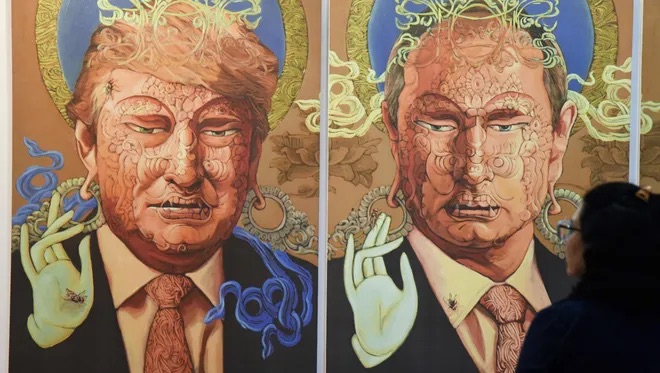
KJS Money bags DC / Kremlin lobbyist in chief
We need to stop letting Russia’s antiquated imperial ambitions occupy the center of global policy while genuine civilizational challenges go unaddressed.
Imagine what we could have built.
Not the world we have—where trillions flow to manage Moscow’s chaos—but the world we didn’t get. The climate infrastructure we didn’t build. The pandemic response systems we didn’t create. The scientific collaboration we didn’t pursue. The economic, supply chain and energy integration we didn’t achieve.
While we’ve spent three years calculating Ukraine’s ammunition needs, what didn’t we solve?
That’s the real game. That’s what Russia won.
The Opportunity Cost Nobody Counts
Since 2013, Russia has maintained frozen conflicts across four theaters. Ukraine alone has absorbed over $200 billion in Western aid. Add defense spending increases, energy market disruptions, diplomatic bandwidth, intelligence resources redirected to counter Russian operations.
Now add what economists call opportunity cost: what we could have done with those resources instead.
$200 billion funds the entire Global Fund to Fight AIDS, Tuberculosis and Malaria for a decade. It’s half the investment needed to meet Paris climate commitments. It’s comprehensive pandemic preparedness infrastructure for the developing world.
We didn’t do any of that. We bought artillery shells.
But the real cost isn’t financial. It’s temporal. It’s focus. It’s the innovation that doesn’t happen when your best minds are managing crises instead of solving problems.
Every diplomatic hour spent negotiating ceasefires is an hour not spent on climate treaties. Every think tank paper analyzing Russian military capability is one not written on biosecurity. Every NATO meeting about eastern flank security is a meeting not held about water scarcity or food systems.
Russia doesn’t need to beat us militarily. They just need to keep us busy.

The Game Theory of Permanent Crisis
Here’s what Russia discovered: being a viable threat is more valuable than being a viable power.
Traditional game theory assumes actors want to win. Russia’s innovation was recognizing that preventing others from winning is cheaper and more sustainable than winning yourself.
The math is simple. Russia spends $80 billion annually on defense. The West spends over $1 trillion responding to threats Russia creates. For every dollar Moscow invests in disruption, the West invests fifteen in management.
That’s not a war Russia is losing. That’s a war Russia redesigned.
The frozen conflict model—Transnistria, Abkhazia, South Ossetia, Donbas—isn’t military failure. It’s strategic success. You don’t need to win territory. You just need to prevent anyone else from moving forward. Create enough instability that your adversaries spend all their energy on containment instead of advancement.
This is the doctrine operationalized. Not swift military victory but permanent, low-intensity crisis that drains adversary resources below the threshold of direct conflict. The goal isn’t conquest. It’s exhaustion.
What the Villain Role Produces
Russia’s conventional military performance in Ukraine has been catastrophic. Rigid command. Massive losses. A $10 million tank destroyed by a $500 drone. This isn’t the fearsome Red Army—it’s a force barely holding ground against a smaller opponent.
But Moscow keeps going. Not because it’s winning tactically. Because tactical victory was never the objective.
The real victory is what Russia prevented while we were watching Ukraine. The Global South observed Western unity fracture over aid commitments while climate finance remained inadequate. China watched NATO cohesion strain under pressure while advancing Belt and Road unchallenged. Cybersecurity resources got redirected to Ukrainian infrastructure while ransomware operations expanded globally.
The illicit economy—trafficking, smuggling, financial crime—flourished in the attention vacuum.
Russia’s military may be impotent, but its role as civilizational villain is incredibly productive.
The Supply Chain of Crisis
We talk about supply chain disruptions from the war. Energy prices. Grain exports. Fertilizer shortages.
But the deeper disruption is cognitive. Russia has captured the global security agenda. Every major policy discussion begins with “how does this affect the Russia situation?” That framing alone is a strategic victory.
It means Russia determines what we think about. What we prioritize. What we consider urgent.
We’re not building the future. We’re managing Russia’s past—their imperial nostalgia, their great power fantasies, their wounded pride over losing the Cold War.
And every year we spend doing that is a year we’re not advancing on genuine civilizational challenges. Climate adaptation. Pandemic preparedness. AI governance. Water security. The rise of authoritarian techno-states.
Those threats don’t wait while we deal with Russia. They compound.
What We Didn’t Build
If we weren’t occupied by Moscow’s frozen conflicts, what would we have?
Functional climate agreements without petro-state obstruction. The global plastics treaty that collapsed in Geneva after 234 fossil fuel lobbyists—many Russian-aligned—gutted the final text. Real progress on methane emissions, shipping regulations, binding carbon commitments.
Pandemic preparedness systems built from lessons we learned but never implemented. Early warning networks. Distributed vaccine manufacturing. Surge capacity for medical supply chains.
Economic integration that lifts billions out of poverty instead of fragmenting into competing blocs.
Scientific collaboration that accelerates breakthroughs instead of siloing behind security classifications.
Peace dividends that fund education, healthcare, infrastructure instead of weapons systems designed to counter threats that exist primarily to justify their own funding.
We could have built all of that. We’re capable of it. We have the resources, the knowledge, the technology.
We just spent it somewhere else. On Russia. On managing chaos Moscow engineered specifically to prevent us from building anything better.
The Path Forward
This isn’t an argument for abandoning Ukraine. That would validate the entire strategy and invite repetition everywhere.
It’s recognizing that matching Russia’s commitment to permanent crisis is exactly what Moscow wants. Real victory means making Ukraine’s security sustainable without permanent Western dependency. It means investing in technologies that make attritional warfare obsolete rather than competitive.
Most importantly, it means reclaiming the initiative. Treating Russian provocation as background noise requiring management, not foreground crisis requiring total focus.
We need to stop letting Russia’s antiquated imperial ambitions occupy the center of global policy while genuine civilizational challenges go unaddressed.
Russia wins when we’re too busy with Russia to build anything else.
That’s the game. The distraction is the strategy. The opportunity cost is the crime.
 whatever because