And Talk About Why It Matters More Than We Know.
This week, Brazil doubled down on protecting the Amazon. In a revised national climate plan, the Lula government committed to conserving 80% of the Brazilian Amazon and eliminating deforestation by 2030.
A new $120 million fund — ARPA Comunidades — will directly support 130,000 people living inside 60 protected reserves, helping them build livelihoods from standing forest rather than cleared land.
This is good news. Real good news. And it deserves more than a retweet.
Here’s why it matters at scale and why most coverage isn’t doing it justice.
The Northeast Is the Whole Game
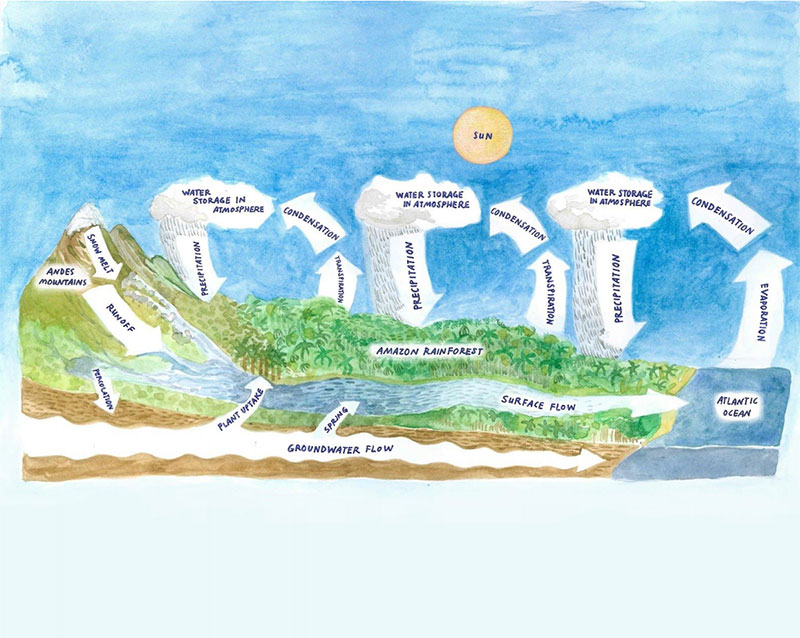
The Amazon doesn’t work like a bathtub you can drain slowly and refill later. It works like a circulatory system. Moisture enters from the Atlantic Ocean in the east, rains down, gets absorbed by the forest, evaporates back up, and travels west — creating what scientists call “flying rivers” that generate up to half of the Amazon’s own rainfall.
Deforestation is not created equal when you’re talking about the tipping point. The tipping point will likely be triggered in the east, because that’s where the moisture cycle begins.
And the eastern Amazon is already in crisis.
The eastern third of the Amazon biome has already lost 30.8% of its original forest — above the speculated tipping point threshold of 25%. The dry season over the eastern and southern Amazon is now four to five weeks longer than it was in 1979. It is two to three degrees warmer and 20 to 30% drier.
Scientists warn that at 20 to 25% deforestation — combined with climate change and fire — the Amazon hits a tipping point where 50 to 60% of the entire forest could convert to savanna. Irreversibly. Not in centuries. In decades.
Losing 50 to 70% of the world’s largest tropical forest would release 300 billion tonnes of carbon into the atmosphere — making it impossible to …. meet the Paris Agreement target.
This is not a regional story. This is a planetary systems story with a known threshold (villan), a known geography, and a closing window.
It should be getting picked up on every major news outlet combined with our continued to awareness and how we can help the Amazon….
The Governance
Here’s what Brazil just proved that the rest of the world should pay attention to: protecting a critical system requires naming the threshold, protecting the most vulnerable node, and putting communities — not corporations — in charge of the margin of safety.
The eastern Amazon is your circuit breaker. Let it go, and the whole system follows.
Sound familiar? It should. Every complex system — financial, ecological, democratic — has a northeastern quadrant. A place where, if we let the pressure exceed a critical threshold, the cascade begins and we can’t stop it.
(And it seems like we always “find out” well in advance, we warn ourselves. We even write about it before it happens. As it happens…)
The 2008 financial collapse had one. American democracy has one right now. The Amazon has one – scientists have drawn it on a map.
Brazil is governing to the threshold. They identified the most vulnerable node. They funded the communities holding the line. They treated the forest — correctly — as infrastructure.
They believe in the future.
To the Young People,
Your lungs are partly the Amazon. Not metaphorically — literally. The moisture cycles that regulate rainfall across South America, that cool temperature gradients across the Atlantic, that keep 10% of the world’s biodiversity alive, are generated by a forest that is 17% gone and 31% gone in the east, where it matters most.
Brazil just chose to protect it. They did it by investing in the people who live there, because small reductions in extreme poverty in the Amazon yield large declines in deforestation. Communities first. Standing forest second. Carbon third. In that order, because that’s the order that works.
This is what governance looks like when it’s trying to save something instead of extract it.
Remember what it looks like. You’re going to need to demand it everywhere.
KJS DC 3.26
 whatever because