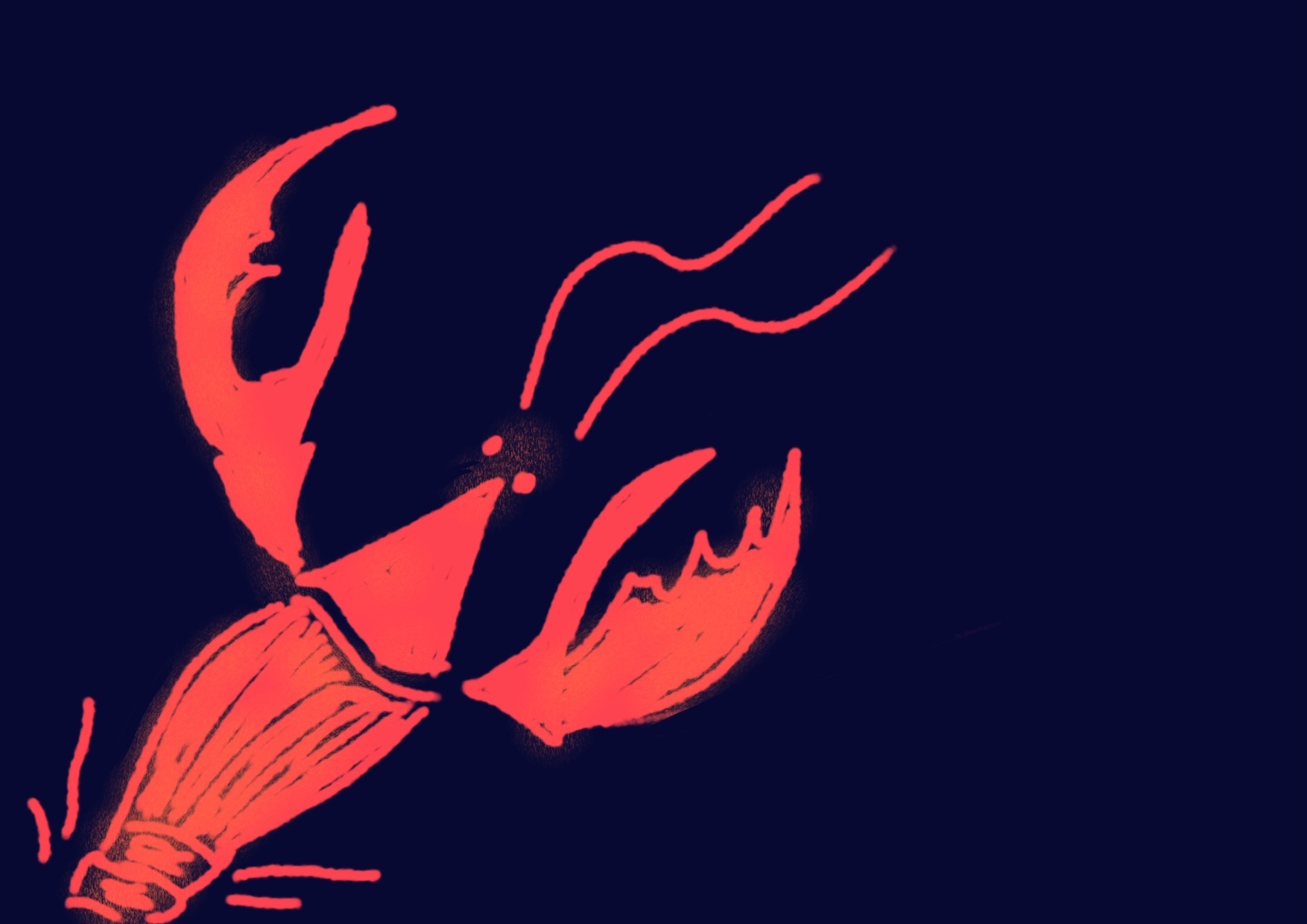
A Lobster Parable For Our Time
KJS 3.26
In the beginning, we discovered fire.
We were cold, we were hungry, and something bright was warm. So we swarmed it. All of us. And it was good — until we burned down the forest we lived in. Then we shrugged, moved to the next forest, and did it again.
This is us. This has always been us.
In 1921, a brilliant chemist named Thomas Midgley Jr. solved two of the most pressing problems of his era. Engines were knocking — so he added lead to gasoline. Refrigerators were exploding — so he invented a stable chemical coolant called Freon, a chlorofluorocarbon. He won every major award chemistry had to offer. He was elected president of the American Chemical Society. Environmental historian J.R. McNeill later concluded that Thomas Midgley Jr. had more impact on the atmosphere than any other single organism in Earth’s history.
He didn’t mean it as a compliment.
Midgley didn’t realize those gases would blast a hole in the Earth’s ozone layer, which absorbs cancer-causing UV light. The lead he put in gasoline raised atmospheric lead concentrations by a factor of 650. Generations of children were neurologically impaired. The ozone hole is still healing. Freon molecules released in 1985 are still drifting in the stratosphere. One man. Two technologies. The entire sky.
We didn’t stop. We never stop.
DDT was going to end malaria. Its inventor won the Nobel Prize in 1948. It nearly ended the birds. Plastic was going to make everything cleaner, cheaper, safer. It is now in human blood, placentas, the deepest ocean trenches, and the lungs of every child alive. Social media was going to connect the world. It did — and handed authoritarian governments the most sophisticated surveillance and radicalization engine in human history, gift-wrapped and ad-supported.
Every time: a genuine problem, a brilliant solution, a swarm. Schoolkids. Retirees. Investors. Governments. Everyone descending on the new thing like it’s the last food on Earth.
And now, in Chengdu and Hefei in 2026, apartment blocks emptied by China’s real estate collapse have been converted floor by floor into AI-managed lobster tanks. Schoolchildren are competing to see whose algorithm grows the fattest Australian Red Claw crayfish. Retirees monitor their “flocks” from smartphones, gamifying aquaculture from their living rooms. A $100 plug-and-play kit. An app. A market. A movement. A revolution, they’re calling it.
Nobody asked what happens when a careless hobbyist tips an Australian invasive species into the Yangtze. Nobody calculated what a million apartment pumps running 24 hours a day does to the power grid of a city that already burns coal to keep the lights on. Nobody modeled the water consumption against the aquifer.
They didn’t ask because the technology was right there, the economy was desperate, and the app was free.
This is the pattern. It is ancient and it is us. A problem appears. A technology arrives. We swarm. We scale. We look up — years, decades, generations later — and the solution has become a new catastrophe, usually larger and slower and harder to reverse than the original problem it solved.
Here is what the pattern tells us: the Earth is not waiting for us to figure this out. It is absorbing our consequences with the patience of 4.5 billion years of practice. The ozone layer heals at its own pace. The ocean distributes our plastics on its own schedule. The species we drive extinct do not return when we apologize.
We are not the apex of this story. We are a very loud, very brief, very messy chapter in a book that was already ancient when the first fire went up.
The lobster in the Yangtze doesn’t know it’s an invasive species.
Neither do we.
 whatever because