KJS DC 3.26
Political science majors unite, form of: pattern recognition
There was a study you definitely missed in school.
It came out in September 2014. Two political scientists — Martin Gilens at Princeton and Benjamin Page at Northwestern — published a paper in Perspectives on Politics titled “Testing Theories of American Politics: Elites, Interest Groups, and Average Citizens.”
I’m sure you missed it. It was peer-reviewed. Rigorous. 12 years of policy data across nearly two decades of American governance.
Here is what they did. They built a dataset of 1,779 distinct policy issues — real votes, real proposals, real decisions — and for each one they tracked three things: what average Americans wanted, what economic elites wanted, and what actually became law. Then they ran the numbers to find out whose preferences drove outcomes.
Their analyses suggest that majorities of the American public actually have little influence over the policies our government adopts.
It tested the most fundamental promise our country ever makes to us. And found that promise was already broken.
When they isolated the preferences of average citizens from those of the wealthy and ran the full multivariate model, the statistical impact of what the majority wanted dropped to a non-significant, near-zero level.
Near zero.
The central point: economic elites and organized groups representing business interests have substantial independent impacts on U.S. government policy. While mass-based interest groups and average citizens have little or no independent influence.
So way back then we were alerted that: when the wealthy want something different than the majority, the wealthy win. Every time. You can set your watch by it. And nothing changed?
Gilens and Page were careful with their language. They called it “economic elite domination.” The journalists who covered it called it the oligarchy study. I checked: there was a few weeks of headlines, some cable news debate about the methods and a few op-eds.
Then nothing.
No constitutional reckoning. No campaign finance overhaul. No structural reform of any kind. We got the receipt for fraud and put it in a drawer.
And who did that – the Average citizen?
Unforgivable
The data in that study covers 1981 to 2002. That means the researchers were describing a system that was already functionally oligarchic before the smartphone and social media, before Citizens United blew the doors off campaign finance in 2010, before Elon Musk bought the town square, before billionaires sat front-row at inaugurations as their government contracts are being renewed.
You see what’s happened here, don’t you Average American? It’s a generational Ponzi scheme of magnanimous proportion.
This is not conspiracy. The system isn’t broken; it’s fixed.
So, on paper we have no power. All the power can easily be returned to its source via protest of enabling systems and processes. Common understanding and simple Coordinated actions will solve for this. I suppose we can wait for the elite to create less elite accountabilities or special interests to decides not be special. Or do it ourselves.
If that was a snapshot of oligarchy in 2002, the last two decades getting more comfortable, this is why it seems so open today.
Are average Americans irrelevant?
Don’t we care.
You were taught that America is a majoritarian democracy. That your vote is the fundamental unit of political power. That representatives represent you. That elections are the mechanism through which the will of the people becomes law.
I have a friend down in Boca Raton Florida where the Mayor just won by one vote. HIs vote really mattered. That makes me feel good.
There is strong empirical support and I have a deep seated feeling that policymaking is dominated by powerful business organizations and a small number of affluent Americans.
I don’t even like admitting it because you live in its continued reality and feel violated.
If policymaking is dominated by powerful business organizations and a small number of affluent Americans, then America’s claims to being a democratic society are seriously threatened. That sentence was written in 2014.
In 2026, this is no longer a theoretical framework. Billionaires are 4,000 times more likely to hold office than you are. The richest man on earth ran a federal agency while holding billions in government contracts. The Supreme Court ruled that money is speech and corporations are people. The senators who write tax policy are funded by the people those taxes would affect.
This isn’t corruption in the way we used to mean it — the envelope of cash, the back room, the quid pro quo. This is structural. Legal. Normalized.
The Gilens and Page study didn’t describe a scandal. It described an operating system.
That operating system has had twelve years of upgrades since they published.
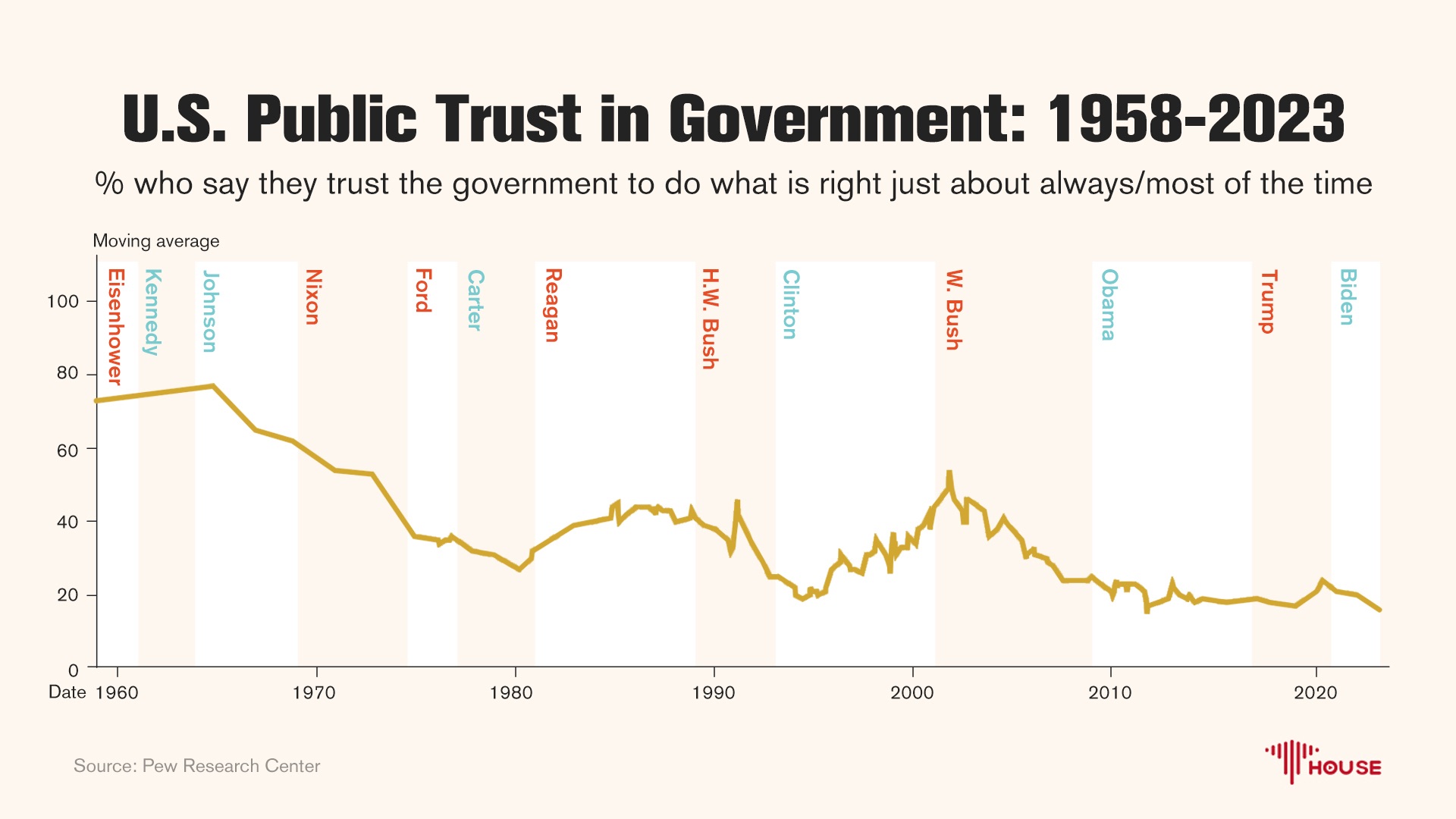
It’s no wonder our trust in government is abysmal.
 whatever because