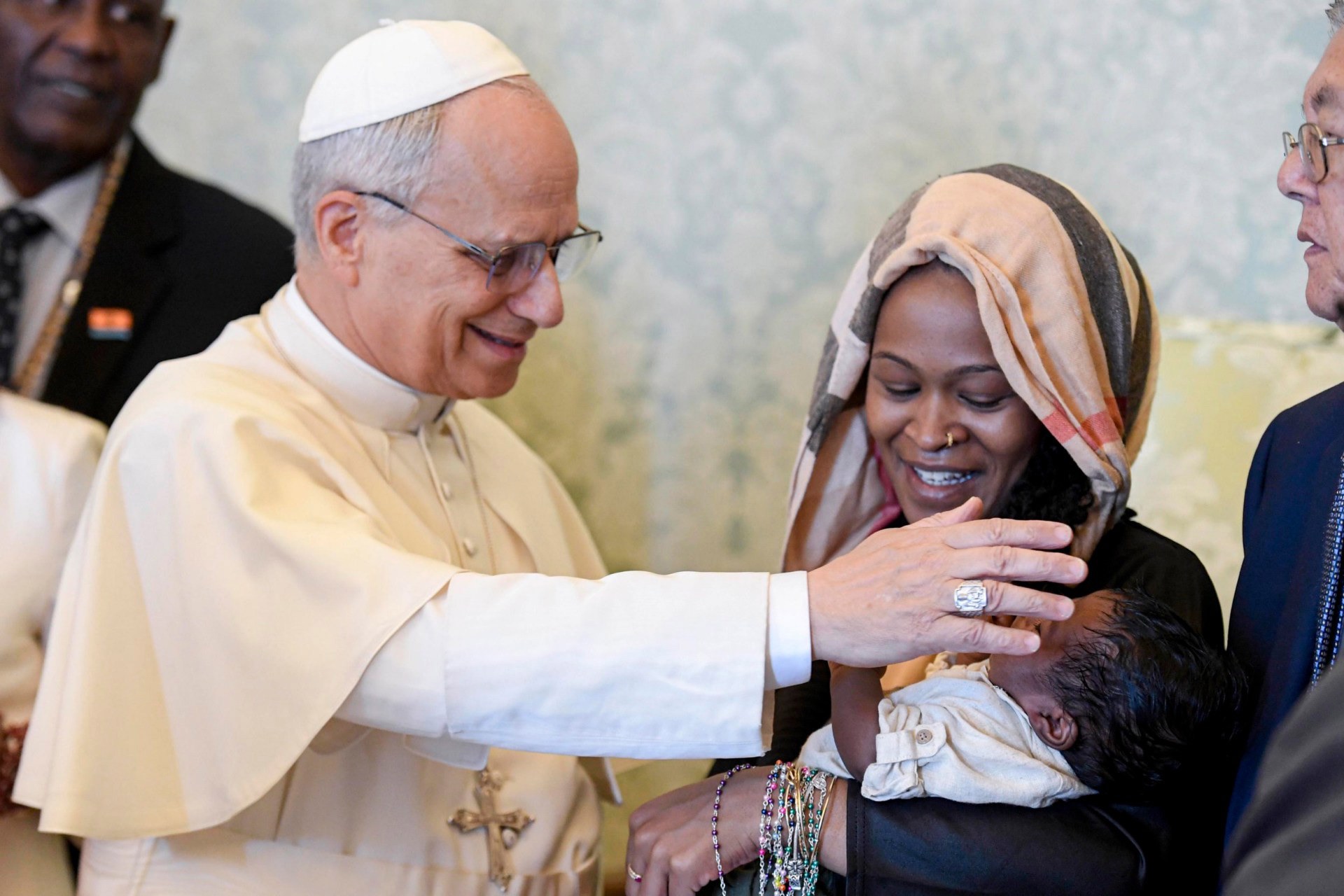
Imagine a Love Thy Neighbor State Department.
While we’re on the subject, walking the line where faith and politics collide.
The contrast between these two foreign policy visions is stark, fully documented and polar opposite.
On the same day Pete Hegseth fired his Army Chief of Staff, the first American pope stood before the president of Cameroon and offered a different theory of how nations might treat each other.
There are currently two Americans articulating a vision of how the United States should engage the world. One of them commands the largest military on earth. The other commands no army at all. And the one without an army is, at this moment, winning the argument everywhere outside Washington.
Pope Leo XIV arrived in Yaoundé on Wednesday, delivering remarks against the “whims of the rich and powerful” and calling for peace in a country roiled by sectarian conflict. He stood before a 93-year-old president who has held power for 44 years and said without diplomatic softening: “In order for peace and justice to prevail, the chains of corruption — which disfigure authority and strip it of its credibility — must be broken.”
He went further. “We are living at a time when hopelessness is rampant and a sense of powerlessness tends to paralyze the renewal so deeply desired by peoples,” he said. But then — and this is the move that distinguishes his doctrine from every foreign policy framework currently operating in Washington — he did not pivot to force. He pivoted to hunger. “There is such a hunger and thirst for justice. A thirst for getting involved, for a vision, for courageous choices and for peace.”
This is not sentiment dressed as policy. It is a rival operating theory — one that has a centuries-long track record in some of the world’s most intractable conflict zones, and one that the current US foreign policy establishment has systematically dismantled in favor of what it now literally calls the Department of War.
“Peace, in fact, cannot be decreed: it must be embraced and lived,” Leo said in Cameroon. That single sentence contains a foreign policy doctrine that inverts every assumption currently governing US action in the Middle East. The Trump doctrine — oil blockades, ultimatums, civilizational threats, naval enforcement — is predicated on the belief that peace can be coerced from above. Leo’s doctrine says coercion produces submission, not peace. That the only durable security is behavioral, not imposed.
He argued that religious traditions can “inspire prophets of peace, justice, forgiveness and solidarity” — and that when religious leaders are involved in mediation, politics and diplomacy “can draw upon moral forces capable of easing tensions, preventing extremism and promoting a culture of mutual esteem and respect.”
Translate that out of theological language into foreign policy terms and you have: soft power, community trust, authentic messengers, behavioral readiness. You have, in other words, the opposite of what the United States has deployed in the last six weeks.
Trump responded to all of this by calling Leo “WEAK on Crime and terrible for Foreign Policy” and posting an AI-generated image of himself as a Jesus-like figure laying hands on the sick.
Leo answered from the papal plane: “I have no fear of the Trump administration or of speaking out loudly about the message of the Gospel. Too many people are suffering in the world today. Too many innocent people are being killed. And I think someone has to stand up and say there’s a better way.”
That is a foreign policy statement. It is also a theological one. The distinction Leo refuses to accept — the one Washington insists upon — is that these are different things.
Jesus said love your neighbor. He did not specify which neighbors qualified. He did not issue an 8pm deadline. He did not call the ones who disagreed with him weak.
The Department of War has a $825 billion budget, 3 million personnel, and the most lethal military force in human history. It is currently six weeks into a conflict with no exit strategy, no authorization from Congress, and a commander who just fired his Army Chief of Staff mid-campaign over a loyalty dispute.
The pope has a plane, a staff of diplomats, and the moral authority of 1.4 billion people.
“The world needs the message of peace, justice, tolerance, forgiveness, and love that you bear,” said Cameroon’s president — not to Washington, but to the American standing in front of him who had come to listen rather than to threaten.
One of these two Americans is operating from strength. It is not the one with the bombs.
 whatever because